The harder it is, the easier it gets! part 2


Part 2
In Part 1 we went over the elements that shape the obstacle into a well rounded instrument that helps us draw our audience in and shape our character’s journey and the character herself. Let us recap those elements. First, the obstacle has to be credible, specifically, the character’s disposition to face it. Second, the higher the stakes, the more we should rely on the character’s instincts, which are universal, rather than heroism or skill, which are uncommon and unrelatable. Lastly, all stories can, and should, be written in the context of group dynamics, that is, our character is not alone in trying to overcome the obstacle.
Let us explore now some situations where some of these elements are not readily applicable and/or the obstacle is harder to define.
“We’ll never survive!
The Princess Bride. Script by William Goldman.
Nonsense. You’re only saying that because no one ever has.”
So, what if your story is about a single person, no friends, no villains, no obstacles, just reality getting in the way?
The character may be alone and he may well not have an enemy. But. There is always an obstacle. Always. And it always shapes our character. If your story is indeed about a loner, then never is the concept of the obstacle being life defining more true than in this case. Think about Cast Away, and what the obstacle of that story is. At first, we might think the island itself is the obstacle, and later on as our hero sails away, the sea. In truth, the obstacle is always isolation. Being isolated prevents the character played by Tom Hanks from accessing the modern comforts he relies on for survival. Once he becomes self sufficient in this new environment (character evolution), isolation still prevents him from realizing his social and spiritual needs, his desire for companionship and love. At this point, he can continue to subsist on the island indefinitely, but has to make the decision of whether he wants to live in such a way. He chooses to end his life on his terms, but can’t go through with it, his self preservation instinct too strong. Eventually, an opportunity presents itself that leads him to build a vessel and venture out to face the last manifestation of the isolation obstacle, the sea, a trial that will result in either death or being found. The obstacle has forced the character to evolve in different ways. First, he becomes skilled in primitive survival methods, the exact opposite of his previous plush existence, concerned only with the menial requirements of his corporate job. Then he evolves further by understanding that the willingness to give up his life should not result from desperation, but from the possibility of success, however remote. We agree that this character deserves to die at sea trying rather than by suicide if he is to die at all. He has fought too hard not to die fighting. Whichever the outcome, he has truly done everything he can. Talk about an obstacle shaping a character!

By contrast, the story of The Martian, though also about a character surviving harsh odds in isolation is quite different. Mark Whatney has all the means and knowledge for survival, his vast scientific intellect more than a match for the situation. He knows that if he can survive long enough, NASA will realize he is alive and hopefully launch a rescue mission in time to save him. Thus, his plight is not so much about survival but about extending this survival. The obstacle in this story is time, specifically, the passage of it. It is a challenge with a definitive possibility for success at the end of the line, and thus, we never see his resolve falter or his disposition sour. He remains committed, even optimistic, through the whole ordeal. As a scientist, his survival is a problem that can, and must be, solved with science, and facing it as such puts him in familiar, comfortable territory. Whatney’s character does not so much evolve as he faces the obstacle as he simply reveals the kind of person he is. We, the audience, are the ones changed by observing this man’s refusal to be put down by seemingly insurmountable odds. Every time we feel there is no way out of a new situation, Whatney shows us a solution. It is an uplifting story from start to end, amplified by the decision of his team to spend an extra 500 days of their lives in space to save him. On the other hand, the evolution of the Tom Hanks’ character is fraught with doubt and uncertainty at every step, the future not so important as the present. Even the final act of triumph comes at great personal cost for he loses the love of his life. He is, once again, isolated now that he is back in civilization. His final challenge will be to overcome this new form of isolation, and as he follows Bettina’s truck, he may well be on his way to do so. Whatney’s final challenge will be to use all that time lost lived in Mars, and the time spent by his friends and those who raced to save him, for something productive. Instead of retiring after such an ordeal, he becomes a teacher, a mentor to future astronauts. Time and Isolation. Obstacles that resonate with us, for at one point or another, we all have lost precious time that we can never get back, or have isolated ourselves from the things that truly matter. These obstacles make the plight of individual characters truly universal.
And now, the end is near and so I face the final curtain…
Paul Anka
What about stories where the obstacle is not surmountable? Say, someone dying from an incurable disease? Well, however untimely, death is inevitable so it isn’t really an obstacle. In this case, time is. What does the character want to accomplish before his passing, reconnect with estranged family, finish writing a novel, right a past wrong? Bucket list stories are popular in this category. Especially in a comedic setting, where the seriousness of the situation gets juxtaposed to the absurdity of certain goals. I once evaluated a script where the main character, upon learning he has a few months left, decides to blow himself up at a military parade with the purpose of taking the country’s dictator with him. It was a well written, taut thriller that resonated because the writer hailed from a small country that lived under such a dictatorship. It also had the added twist of the character’s condition suddenly worsening, making it doubtful he would succeed. Another script that passed through my hands, where the main character was similarly ill, had him search for his long lost first love from adolescence, only to find out she had died just months earlier while spending her last months searching for him as well! The payoff from this seemingly no-win story was that, the daughter of the main character, who helped him in his search, and the son of the lost love, get to meet and strike a genuine friendship that may well end up in true love. From the ashes of lost love and ending life rises a new relationship. In these cases, the characters decided to use the obstacle itself, borrowed time, as a push to embark on one last quest. The obstacle shifts from being a deterrent to the exact opposite, a catalyst. It is a great philosophical juxtaposition. Such stories teach us about the human condition, to consider something so important as to be a person’s last wish, and yet not be brave enough to chase after it otherwise. It is a vast tapestry on which to weave a story that can be full of turns and twists, having a character face her final chapter, with the obvious transition from despair, to acceptance, to clarity of mind, and finally, the urge to accomplish one last feat of consequence.
It is strong sure, but is it sublimely tasteful?
As I have mentioned before, the Storytelling Principle can be applied to any creative writing, including marketing copy. And if the obstacle is about the most important component in storytelling, it follows that when promoting a product, we need to present an obstacle for such product to overcome. In this case, our hero is the product and the obstacle is whatever need the product fulfills. If we choose to have a villain, it could be anything that conspires to prevent the product from delivering the goods, such as an inferior competitor, high prices, unfavorable markets. In this case, the hero/product must be able to provide a benefit/overcome and obstacle, that is uniquely creditable to it, something that only it can do or that it can do better than the others. And this advantage must be expressed in no uncertain terms.
A few years back I sat in on a meeting at a friend’s agency for the launch of a new product. The customer was a coffee brand, which was introducing a line of exotic varietals from around the world and wanted to assure their customers these coffees continued the company’s tradition of producing strong blends while boasting unique, delicate flavors. I heard plenty of variations on the expected “Strong yet Beautiful” theme, including the concept the younger team members seemed to be favoring, which showed a ballerina performing complex maneuvers while her hair floated suspended in the air during jumps, courtesy of slow motion capture. She would then sip coffee contentedly after the hard training session while the client mandated slogan “Exotic Varietals, Energy and Great Taste” capped things off. I felt the idea, although not terrible, was hardly original and, more importantly, not very effective. It made all the more sense, the authors claimed, because the agency had already worked with a famous ballerina on another campaign. A lot of creative agencies favor these artsy concepts because of how aesthetically pleasing they are, but often forget how little the average consumer can relate to something as ethereal as a gracefully pirouetting ballerina. 99% of all agency work nowadays follows these predictable patterns, which have more to do with the latest fashion in production (at that point, the slow motion/speed ramp effects were all the rage) and few, if any, of the fundamentals are adhered to. When finally asked for an opinion, I respectfully offered that as a person who actually gets up at the crack of dawn every morning and relies on a good cup of coffee to start my day, I would never buy this product because of an expertly photographed ballerina. Most coffees, unless decaf, offer a jolt of energy, so this should be the common thread between our hero/coffee and the rest, I added. Where our hero excelled, however, was in delivering that energy with great taste, which was the obstacle all other brands could not overcome. So, show our coffee overcoming this obstacle and you have something instantly relatable. About a week later, my friend (owner of the agency) sent me a script that they felt captured my advice. Here it is:
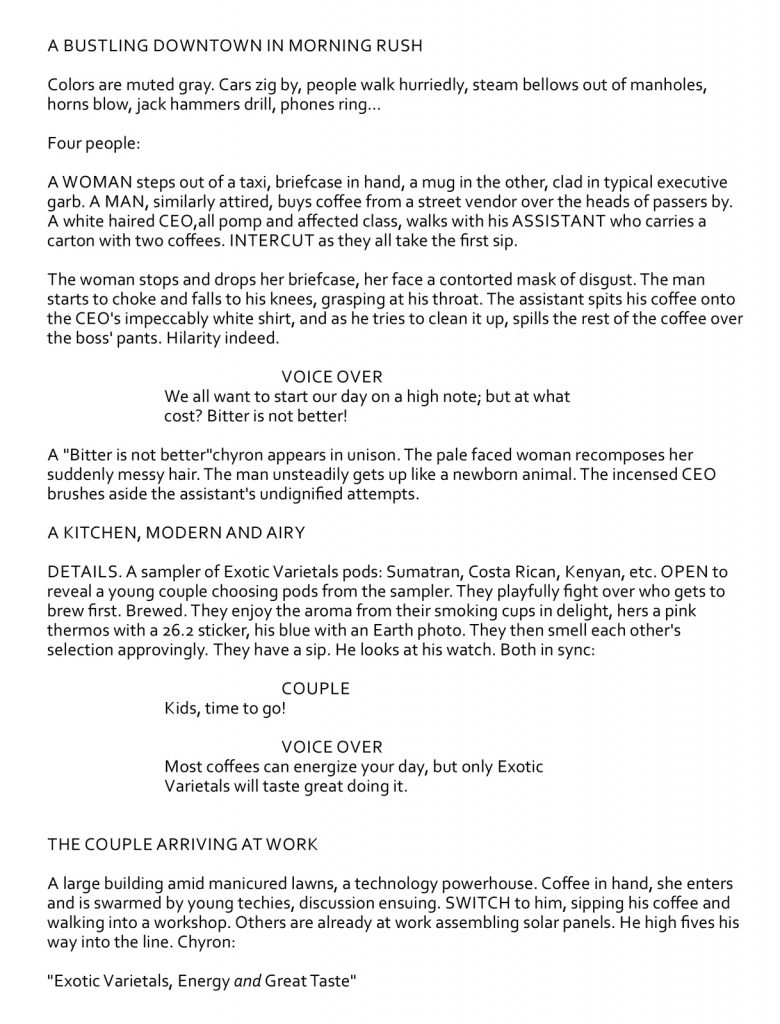
Great! I said. I loved the association of the bitter coffee with the heartless executive types and the Exotic Varietals being the choice of morally conscious everyday people. The “Bitter is not Better! tagline worked great too, and resonated with all of us who at one point or another have had a crappy cup of coffee. The Storytelling Principle at its best. By acknowledging that strong coffee can, and usually does, taste rather awful, and then reminding us that this need not be the case, our product has clearly overcome an obstacle, and we have made buyers a promise that they will be eager to take us up on. By contrast, the ballerina concept never established an obstacle or an advantage for our product, rather, it asked us to associate ethereal imagery with a slogan. You can see which approach works best.
So… what do heroes need? OBSTACLES!
Exercise:
Find some ads of products you like or use, and change the ads to reflect the Storytelling Principle with the product overcoming an obstacle/providing a distinct service, and see if it works better than the original ad. Please share in the comments.