Forging the Path Ahead


Welcome back writers!
I wanted to address several concerns that invariably get raised by fellow writers when we discuss the Storytelling Principle as a writing tool.
Is Storytelling based writing a style, a way to write?
Storytelling based writing is NOT a style. It is simply a construct, a premise, around which you structure the theme of your writing. If you appeal to those universal feelings that your audience has developed through their own life stories, you are very much in Storytelling mode. You can continue to use whatever rhythm, cadence, words and tone you favor. That is your voice as a writer, and it is precious and unique. Your voice requires constant nurturing and practice, and it need not be compromised because of your Storytelling approach.
Does writing always need to be Storytelling based to succeed?
Not all writing need be Storytelling motivated. Of course, if you’re writing a TV episode or film script, a fiction story, a biographical or historical account, you already got yourself a story in your hands. It still bears repeating that the stronger the emotional connection your writing makes with its audience, the higher your chances for success. Many a film, including expensive Hollywood fare (or mainly expensive Hollywood fare), fail to register as genuine, thus don’t elicit an emotional response, and we don’t make a personal connection with them. We are not invested. So it follows that, as with every creative endeavor, there is good and bad storytelling. And as with every creative endeavor, there is far more of the latter than the former.
Can commercial copy writing always be Storytelling based?
When it comes to writing copy and other marketing mediums, following the Storytelling Principle is merely an option. That choice will determine your style and tone as a creative writer, and it should be acknowledged that many successful writers have never once in their illustrious careers followed the Storytelling Principle. For every “JUST DO IT”, there have been many “The best running shoes money can buy”, or “The lightest materials for the highest comfort”, or “Scientifically engineered for the best performance”, or…. You get the point. There are many big brands, including Fortune 50 companies with yearly advertising budgets in the hundreds of millions, who rely (insist) exclusively on this type of descriptive marketing. Listing the advantages of a product or touting its superiority is a way to go, no doubt, but personally, it may not the type of writing you want to practice. Now, for a junior writer at a creative agency working for large accounts, you won’t have the choice to develop your own voice until you pay your dues delivering repeatable copy. In some cases, you will never get that choice at all, which is why so many “creative” agencies are anything but. In general though, trying to inject emotion and humanity in what you write will always be beneficial, and a risk you have to take even when constricted by strict brand guidelines and overbearing senior supervisors with inflated egos.
Now for the meat in the potatoes. As promised on the last post, I want to dissect a totally unremarkable TV ad and see why it works. It is a standard 20-second ad with a thirty four word voice-over (V.O.) narration. To shake things up, first I am going to post the text, and then we will read the full script.
“In the arena of life, we will be victorious at times.
While others, we may well finish last.But, despite the outcome, one thing remains the same:
There is always the next race.”
The first thing that jumps at us is the ultra-pasteurized, maximally-processed, lowest-quality-ingredient, cheesiness of it. Dear Lord! Cheeses Christ! This is as fresh as an impostor fragrance perfume! And you’re telling me this thing got made? Sure did. How on earth?! I mean, all of those phrases, either literally or cloned, have been used a thousand times. There isn’t an ounce of originality in that text.
There isn’t.
There does not need to be.
For one, by using concepts so easily recognizable, we have made the ad instantly relatable. There are no weird words, no obscure ideas or elaborate concepts, nothing to make the audience uncomfortable. Also, by not mentioning the actual product we’re promoting, we have kept their interest piqued and eliminated the possibility of a negative association with a disliked brand/product and kept them engaged to the end.Now, let’s look at each sentence on its own:
In the arena of life, we will be victorious at times.
So true. We will win (yay!), and it’s ok if it does not happen all the time (so it’s not just me). Hope with a (small) dash of reality. I can dig it.
While others, we may well finish last.
Don’t we know it. But we are willing to accept this grim certainty since we were first assured that we will also win every now and again. Then, the probability of “may well finish last” actually makes it far more agreeable, since any placing higher than last becomes acceptable. Lastly (pun intended), finishing last shifts the focus to finishing rather than losing. I am feeling heroic already. There is no quitting in me!
But, despite the outcome, one thing remains the same:
This is the set up before the pay off. It tells us that intention is more important than result. Life is a balance between success and failure, but the ad has presented this theme in such reaffirming manner than I am ready to agree with whatever comes next.
There is always the next race!
Indeed. There is no more resonant belief than the value of perseverance.
Now, let us look at the full script.
It is presented in condensed standard film script form as it is far easier to read than the original TV commercial format.
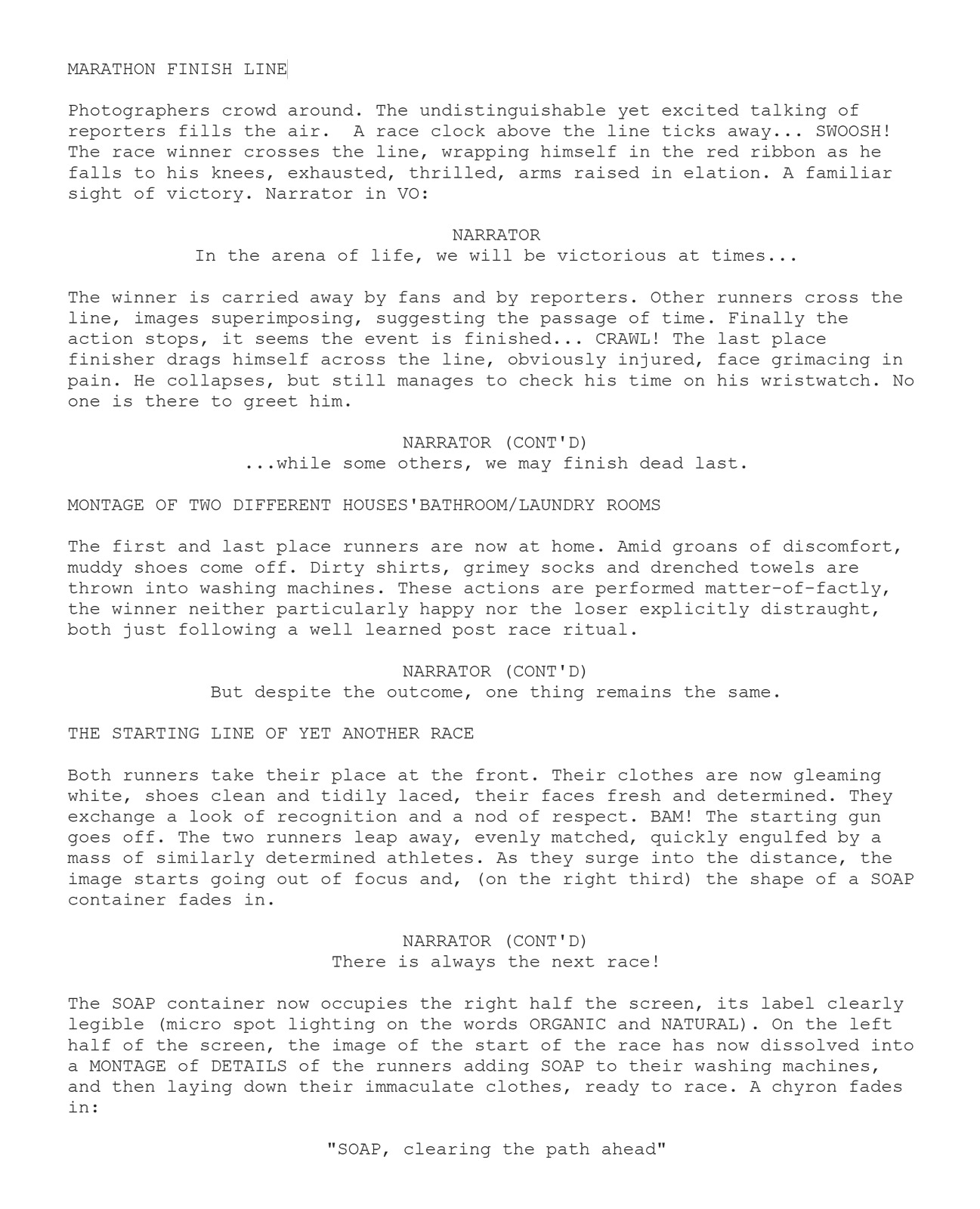
So this is a laundry detergent ad! The original product has been substituted by the word SOAP for copyright reasons. As it was originally written for an Asian country, the verb clearing can mean indistinctly cleaning, forging, opening, and clearing, which makes the tagline “SOAP, clearing the path ahead” very effective. Some of that is lost on the English re-translation (the ad was originally written in English and then translated) but it still plays fine.
“Many a small thing has been made large by the right kind of advertising”
Mark Twain
What makes this unremarkable script a solid performer?
Notice how the extremely graphical nature of the actions (winner falls to his knees in ecstasy, loser drags himself in pain across the line) perfectly complements the text, from the elation of the winner to the agony of the loser, or the crowd’s adoration of the former to their abandonment of the latter. Victory, defeat, adulation, forsakenness. Can we relate? I know I can.
Then, we establish a balance between absolutes, first and last place, reminding us that real life usually happens anywhere in between. Note: During discussions at the creative agency, there were suggestions from one of the senior writers to show the last place runner actually leading the race until the very last corner and then tripping on a rock, injuring himself, and consequently finishing last. Wouldn’t the idea of facing mishap and losing through no fault of his own be even more appealing? I countered that audiences would get finishing last without the need for excuses and that this would actually dilute the impact we were trying to achieve. We ended up shooting two versions of the ad (four actually, more on that lately) and when we tested with target audiences, including the 2400 runners that performed as extras, everyone universally agreed the original version “clicked” better with them. Remember, emotions are spontaneous, the more we compound and complicate them, the less resonant they become.
But don’t over do it! We don’t want to abuse that intimate bond of trust the audience has given us. Let us not try to manipulate their feelings by showing the winner gloating or the loser sunk in a heap of despair. Note: Another suggestion was to show a montage of the winner celebrating with friends and family and the loser being consoled by his own people, instead of the original post race ritual. The idea of leaning on a support team is definitely valid and feels reassuring, but in this case, I felt it would lessen the impact. We are already invested on these two persons because we saw them running their guts out, putting it all on the line. Let’s not break that intimate circle by bringing others into it. Finally, when we see them perform identical post-race routines, we get the idea that they are equals whose fortunes could have easily been reversed. Again, both versions were shot, and again, the original version registered better with test audiences.
Finally, they are ready for yet another race, another attempt, another fresh start. They know each other, they respect each other, and, as the race begins, they are the equal of each other. Notice also how we had the rest of the group “quickly engulf” them. For all we know, neither of them might win or lose this race, the odds are even once again. Humans respond strongly to the idea of equality among competitors because we like to believe that, on any given day, anyone can be the victor. There is no fate but what we make. And rightly so. The idea that all humans have a shot at achieving their goals is not only deeply ingrained in our genetic consciousness, but it is the foundation for democratic societal structure. “All men are created equal” is the foundation of the American Declaration of Independence. More than an idea, it is an ideal, and countless human beings have died defending it. Equality, in its many forms, is right at the top of the heap when it comes to noble human quests.
What about the product itself, why is it shown only at the very end?

Some context. The SOAP company was a market leader which controlled a large segment of traditional demographics for these products. However, their competition were making inroads with environmentally friendly products that were targeted at the younger demographics who value corporate accountability more than the product itself. SOAP came up with a product that ticked all the boxes in terms of being naturally derived, responsibly produced and environmentally safe, but were unsure how to make their image more appealing to the usually corporate-weary younger demographics. My idea was to engage them by showing an activity that is so widely practiced, running, as to be mainstream, thus appealing to large groups within the segment. Then, by telling a universal story that connects not only with runners, and refraining to make it about the product but focusing on the characters instead, we earn a chance to make our pitch. Still, we make that pitch at the very end, and without fanfare.
Conclusion
I feel the goal of creating goodwill with a hitherto unresponsive audience was achieved and a product that was actually tailor made for their needs was introduced very effectively, and thus generated interest. As we have seen, every decision pertaining the creative process of the ad was firmly based on the Storytelling Principle.
Exercise:
Write a one-page Storytelling based ad with the same goal as ours, to introduce SOAP to a young demographic who’s never been a client before. Please share your work on the Comments.
“Start writing, no matter what. The water does not flow until the faucet is turned on”
Louis L’Amour